News archive
Gather questions beforehand – then walk in prepared.
Use “Create Q&A” to open a question wall and share the code before the event. People can send questions in their own time; you see what’s unclear, sort and review – and you arrive ready.
Collect the questions for your next class or event now.
Time should never be a barrier.
With “Personal time”, participants get the additional response time they need – for example, if they have dyslexia, dyscalculia or a visual impairment, or use a screen reader. Minimum points apply after the countdown, keeping the competition fair. You can turn the option off in the quiz editor – keep it enabled wherever possible so everyone can take part fairly.
💬 What works well – and what doesn’t?
We review every anonymous submission within a few days. Serious problems come first. For improvements, we also consider how many people are asking for the same thing.
After a session, we may ask how easy or helpful arsnova.eu was for you. You then tell us what worked particularly well or where you had difficulties. It only takes two clicks.
You can also use “Improve arsnova.eu” at any time, anonymously and without an account or email address. Adding a comment is optional.
Our defining vision: Turning many voices into shared insight
arsnova.eu should do more than collect responses. Our vision is a learning experience in which the thoughts of an entire room become visible, understandable and immediately useful for teaching.
The interactive word cloud reveals the topics that matter to participants. Linguistic normalization transparently brings together different ways of expressing the same idea. Semantic topic analysis identifies questions and viewpoints that are related in meaning. The moderation compass combines these insights with quiz results, points of controversy, signs of misunderstanding and live feedback – and turns them into source-grounded suggestions for the next meaningful facilitation step.
This is the distinctive value we are building with arsnova.eu: an explainable, shared view of the learning situation that connects collective participation, intelligent analysis and actionable teaching guidance.
AI supports educators; it does not make decisions for them. Every statement remains traceable to its sources, educators retain full pedagogical control, and the live experience continues to work in full even when no NLP or LLM server is available.
We are bringing this vision to life step by step through user stories 1.14a–1.14cExternal link: opens another website and user stories 8.9a–8.9cExternal link: opens another website.
arsnova.eu turns the many voices in a learning session into an explainable, shared view – helping educators recognize what matters most for learning right now.
New: Match. Order. Categorize.
Three new question types are here! Invite participants to match concepts, put steps in the right order, and sort content into categories. Turn a simple knowledge check into active thinking – right inside your live quiz.
Create a question and try it now!
Accessibility that benefits everyone
As part of our accessibility initiative, we have comprehensively aligned arsnova.eu with WCAG 2.2 Level AA and tested it both technically and manually. This makes the app clearer, more reliable and more flexible for everyone.
🧭 Find your way around more easily – clear headings, meaningful labels and a visible keyboard focus indicator guide you through the app.
⌨️ Use the app your way – all essential functions work with a touchscreen, keyboard, screen reader and high levels of zoom.
📣 Keep up with changes – concise status announcements let you know when you join, submit a vote or the session moves to a new phase.
⏱️ Answer at your own pace – for questions with a countdown, choose Standard, 10× Time or No Time Limit.
🧘 Reduce distractions – you can hide the live score display. System settings for reduced motion and higher contrast are respected.
📄 Use results accessibly – quiz reports are available as clearly structured, accessible PDF documents conforming to PDF/UA.
Everyone benefits from larger controls, clear feedback and predictable interactions. People who use a screen reader, navigate exclusively by keyboard, need more time or adjust motion and contrast receive reliable ways to participate.
Learn more about accessibility on arsnova.eu
Try the settings that work best for you.
New: The debrief plan as PDF
After a quiz, arsnova.eu shows you more than the results. It also highlights what they mean for your teaching.
⚠️ Spot misconceptions – answers that were wrong but given with confidence.
🧩 Identify gaps in understanding – low success rates or high uncertainty.
✅ Reinforce correct answers – correct, but not yet firmly understood.
🔄 Evaluate Peer Instruction – with a direct comparison of both voting rounds.
🎯 Understand common answer patterns – including misleading options and correct choices that were often missed.
The first page gives you an automatically prioritised debrief plan, including a clear recommendation on where to start. The debrief plan also covers learning progress and confidence, participant feedback, team learning profiles, and a detailed breakdown of every question.
All results remain anonymously aggregated and are presented in a clear PDF.
See an example: Open debrief plan as PDF
Run the quiz, open the debrief plan, and focus your debrief where it matters most.
New in quizzes: Confidence changes the picture
After a quiz, arsnova.eu now shows you more than right or wrong answers. It also shows how confident your participants were when they answered.
At a glance, you can spot:
✅ Solid knowledge – correct and confident: This is settled.
🌱 Fragile knowledge – correct but unsure: This needs reinforcement.
⚠️ Misconception risk – wrong but confident: This is where the debrief gets especially valuable.
🧭 Identified knowledge gap – wrong and unsure: This still needs orientation.
The most relevant questions are placed at the top automatically, so you know exactly where to start the debrief.
You will find the summary at the end of the session, later via “Last evaluation” on the quiz card, and in the CSV export. Everything remains anonymously aggregated. Scores and the leaderboard stay unchanged.
Enable Self-assessment in the quiz editor and try it in your next quiz.
Turn course material into a quiz.
📚 → 🤖 → 🎯
AI-powered quiz generation for lesson prep
Slides, notes, or learning objectives are enough to get started. In your quiz collection, open “Create a quiz with AI”, copy the generation template into your AI chat, and paste in your material.
Then send the review template in the same chat. It balances answer options, strengthens distractors, and checks the JSON before import.
Result: In minutes, you have an importable quiz draft to review in arsnova.eu, fine-tune, and use in class.
Find it in your quiz collection.
Estimate, discuss, compare
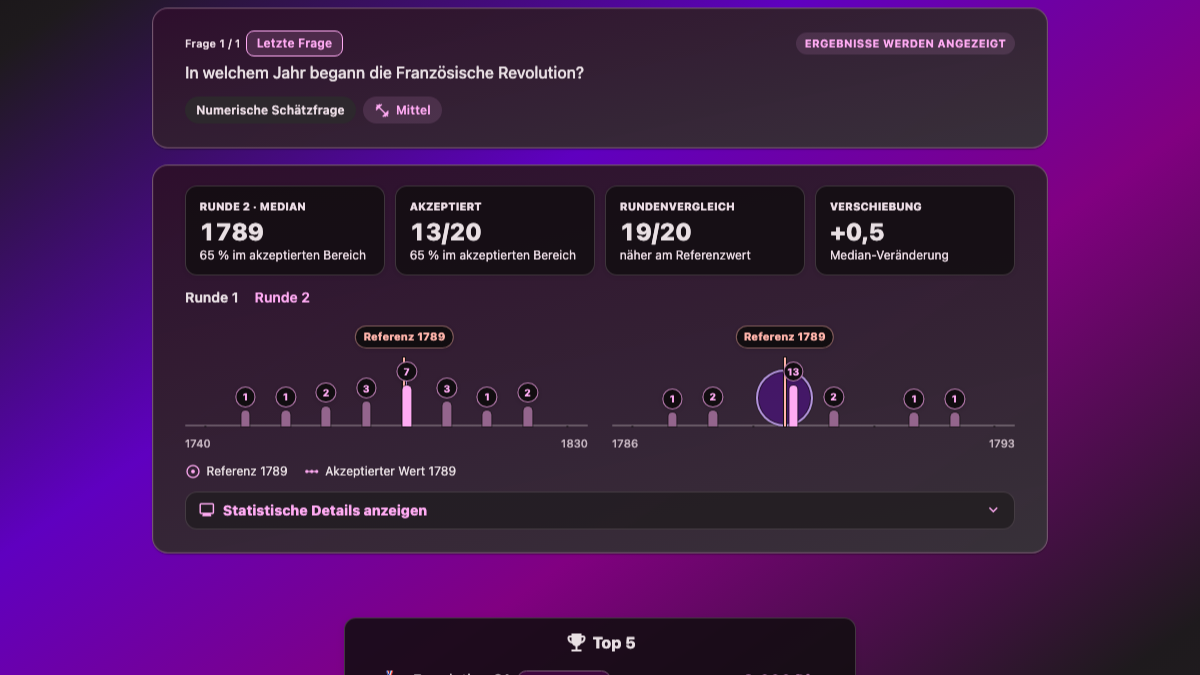
The numeric estimate question lets you collect real number estimates in arsnova.eu, either in a single round or in two rounds with a short discussion in between.
What it is for
- Make prior knowledge visible without revealing the answer too early.
- Let learners estimate again after a discussion.
- Review the reference value, accepted range and the change from round 1 to round 2 in a calm result view.
Details
- Integer or decimal input.
- Absolute interval or relative tolerance band.
- Before results are released, participants do not see the distribution or how close they are to the solution.
- Statistics in the host view stay in an expandable detail section.
Please try the estimate question in a real class. Is the flow clear? Are the graphics and statistics useful? Is anything missing for your teaching situation?
Your feedback will help with the final refinement.
Pace feedback is here
🚀 faster · 🙂 just right · 🐢 slower · 😵 lost
Four icons let your group show live whether they can keep up. Start it in quick feedback and adjust your pace instantly.
Try it
🚀 A Practical Facilitation Concept for Business Meetings & Workshops with arsnova.eu
arsnova.eu is a powerful way to turn any meeting or workshop into an engaging, collaborative experience. This concept gives you a simple, motivating structure you can use right away — whether you're running a strategy session, a team workshop or a customer training.
🌟 1. Purpose of the Session
- Create an open, energetic atmosphere where everyone feels invited to contribute.
- Collect insights quickly and transparently.
- Strengthen collaboration and shared understanding.
- Turn passive listening into active participation.
🧭 2. Suggested Flow (60–90 minutes)
Phase 1 – Warm Welcome & Quick Check‑In (10 minutes)
Start with a short pulse check:
“How are you arriving today?”
This sets the tone and helps you sense the room.
Add one light question to break the ice — no leaderboard, just smiles.
Phase 2 – Input & Instant Feedback (15 minutes)
Share your key message or topic.
Then use a quick poll or a multiple‑choice question to check alignment:
“What resonates most with you so far?”
This keeps everyone mentally present.
Phase 3 – Peer Exchange & Co‑Creation (20 minutes)
Use a question that sparks discussion.
Let participants vote individually, then talk in pairs or small groups, and vote again.
This creates clarity, shared understanding and fresh ideas.
Phase 4 – Q&A Wall (15 minutes)
Invite participants to post questions anonymously.
Upvotes highlight what matters most.
Answer the top questions live — it builds trust and transparency.
Phase 5 – Wrap‑Up & Action Steps (10 minutes)
End with a short quiz or pulse check:
“What is your most important takeaway?”
Use the results to define next steps together.
🧰 3. Preparation Tips
- Create a small set of questions in advance (check‑in, poll, discussion, wrap‑up).
- Keep everything short and energetic.
- Use anonymity to encourage honest input.
- Activate team mode if you want a playful competition.
🎉 Final Thought
With arsnova.eu, your meeting becomes more than a meeting — it becomes a shared experience.
You’ll spark engagement, uncover insights and build momentum that lasts beyond the session.
🎓 Teaching Concept for a Learning Session with arsnova.eu
This concept outlines how to run a highly interactive 90‑minute class session using arsnova.eu. It combines live quizzes, pulse checks, Q&A and peer instruction to create an engaging and effective learning experience. The structure is intentionally low‑threshold so instructors can start immediately without technical hurdles.
🧭 1. Learning Objectives
Subject‑related objectives
- Learners understand the key concepts of the session.
- They identify and correct common misconceptions.
- They apply what they have learned in short transfer tasks.
Cross‑disciplinary objectives
- Active participation from all learners.
- Development of metacognitive awareness (“What do I really know?”).
- Strengthening collaboration through peer instruction and team modes.
- Providing a safe, anonymous space for questions and feedback.
🏗️ 2. Session Structure (90 minutes)
Phase 1 – Warm‑up & Activation (10 minutes)
Pulse Check:
“How confident do you feel about today’s topic?”
Options: Very confident – Unsure – No idea.
Briefly comment on the results to set the tone.
Warm‑up Quiz:
1–2 easy questions to activate the group.
No leaderboard, no competition — just a friendly start.
Phase 2 – Input I + Peer Instruction (25 minutes)
Short Input (10 minutes):
A concise introduction to the core ideas.
Kept deliberately brief to leave room for active learning.
Peer Instruction Question (15 minutes):
- Individual vote via arsnova.eu
- Show results without revealing the answer
- Pair discussion (“Try to convince each other”)
- Second vote
- Reveal and explain the solution
This method promotes deep understanding and makes thinking visible.
Phase 3 – Input II + Transfer (20 minutes)
Short Input (10 minutes):
Further explanation focusing on typical errors and misconceptions.
Transfer Task (10 minutes):
Open question, e.g.:
“What assumption is crucial in this example?”
Collect anonymous responses and discuss selected examples.
Phase 4 – Q&A Wall (15 minutes)
Learners post anonymous questions.
Upvotes highlight what matters most.
The instructor answers the top questions live.
This encourages participation from everyone — including quieter learners.
Phase 5 – Wrap‑up & Evaluation (10 minutes)
Mini Quiz (3 questions):
A short knowledge check at the end.
Optional leaderboard for a playful finish.
Closing Pulse Check:
“How well do you understand the topic now?”
Compare with the initial pulse check to show learning progress.
🧰 3. Preparation for Instructors
- Create quizzes in the quiz library (warm‑up, peer instruction, transfer, wrap‑up).
- Prepare pulse check templates.
- Optionally enable team mode, bonus codes or gamification.
- Use Sync‑ID for collaborative quiz creation if needed.
🧠 4. Didactic Rationale
- Activation: Every phase requires active engagement.
- Formative assessment: Instructors always know where the group stands.
- Peer instruction: Learners learn by explaining — not just listening.
- Anonymity: Encourages honest participation.
- Low threshold: No accounts, no barriers.
- Local‑first: Privacy‑friendly and technically robust.
5. Extensions
- Team mode for group competitions.
- Bonus codes for outstanding explanations.
- AI prompt import for quick question creation (local, no data transfer).
- Export/import for recurring sessions.
🎉 Conclusion
This concept shows how arsnova.eu can enrich a learning session. By combining quizzes, pulse checks, peer instruction and Q&A, you create a lively, interactive and effective learning environment — privacy‑friendly, accessible and grounded in solid educational research.
The Making of arsnova.eu: The AI Revolution Devours Its Children
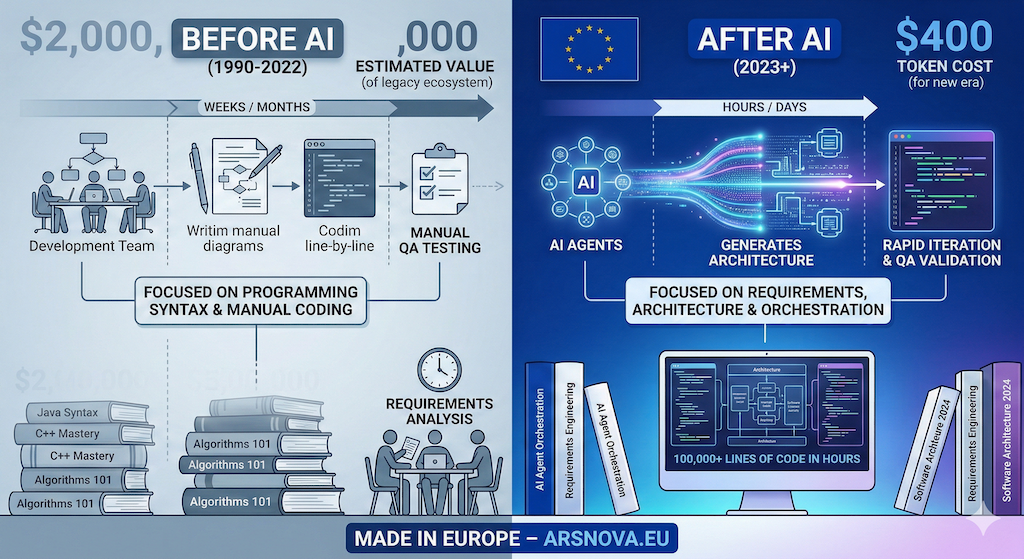
What you're looking at isn't just an update—it's a paradigm shift. The new arsnova.eu was coded entirely by AI agents.
The numbers are staggering: OpenHub estimates the cost to replicate the legacy ARSnova ecosystem at around $2 million; developing arsnova.eu cost just $400 in API tokens. Under my direction, the AI agent generated over 100,000 lines of code in just a few hours. My entire role as Product Owner, architect, and QA tester took less than a single work week.
My appeal: We must radically overhaul the computer science curriculum now! We should stop focusing on memorizing syntax and writing lines of code. Instead, we must teach how to deeply understand requirements and how to act as architects and conductors of AI-driven development. This is the new art of efficiency.
Best regards
Prof. Klaus Quibeldey-Cirkel
arsnova.eu – MADE in EUROPE
One click. You’re live.
Start instant pulse feedback — or run quizzes, polls, Q&A, Peer Instruction, team mode, and bonus codes. Mentimeter-style interaction without vendor lock-in. Kahoot energy with real teaching value. Slido-style Q&A plus full live engagement. No account, no tracking, open source, and free to use.
Try it now